

A child’s sleeping bag needs to balance warmth, room to move, easy packing, and a size that fits the child using it. This guide compares ten options based on the product listing details available, including stated dimensions, temperature ranges, lining, zipper features, carry bags, and wash care. These are listing-based comparisons, not hands-on test results; confirm current specifications and age guidance before buying.
How to use this comparison: Product details below are based on listing descriptions. We have not tested these items hands-on, and specifications can change. Confirm current materials, dimensions, package contents, instructions, and fit before purchase.
Affiliate disclosure: This article contains affiliate links. Babimommy may earn a commission from qualifying purchases.
What to consider before choosing
For outdoor use, choose a bag for the expected overnight low rather than the daytime forecast. A temperature range is not a promise that every child will feel warm at its lower limit. Check the child’s height against the bag’s dimensions, plan suitable sleepwear, and follow the manufacturer’s instructions. For sleepovers or naps, an easy-to-clean bag with a zipper the child can manage may matter more than a compact backpacking design.
10 options, compared in detail
1. Wake In Cloud — Wake In Cloud – Kids Sleeping Bag for Boys Toddlers, Camping in Warm Cold Weather, Backpacking Lightweight Compact Outdoor Liner for 3 Seasons, Space Stars Rockets Galaxy, Navy Blue
Product overview: The stated size (61 x 26 inches) offers a concrete fit check; compare it with the child’s height and room needed to turn over. The listing gives a seasonal or temperature description, which is useful for shortlisting, but it should be matched to the expected overnight low and the child’s clothing. The zipper details are a meaningful practical point: a bottom opening or two-way zip can provide foot ventilation, while snag-resistant wording may help with independent dressing. Wash-care claims are useful for sleepovers and camping, where dirt and spills are common. Check whether the complete bag is machine washable or only the shell can be spot-cleaned. The product’s print, included carry sack, and pack weight distinguish it from simpler indoor sleepover bags.
Advantages: A stated 61 x 26 inches dimension makes comparison more straightforward. A carry sack or compact roll-up format supports car trips and sleepovers. A two-way or foot zipper can give a child another way to regulate airflow.
Disadvantages: Temperature claims depend on conditions and clothing, so do not treat the stated range as a guaranteed comfort rating. Care directions may require a gentle cycle or low heat, which takes longer than a quick wipe-down. Children grow quickly; a close fit today may be short next season, while an oversized bag can feel awkward.
How to use it: Lay the bag flat, open the zipper fully, and let the child climb in before closing it without trapping fabric. On warmer nights, use any listed ventilation opening as directed. Pack it only when dry, and clean it according to the care label; do not assume every bag can be tumble-dried.

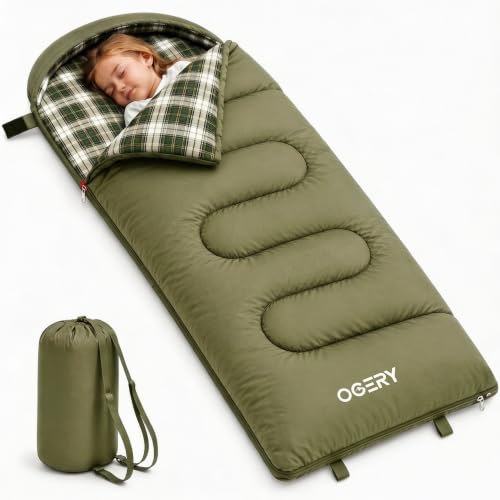
2. OGERY — Kids Sleeping Bag for Camping, 3 Season Toddler Sleeping Bag | Lightweight, Washable, Warm Weather, Camp, Hiking, Travel, Sleepovers, Boys & Girls, Fits Kids up to 4 ft 7 in
Product overview: The listing presents this as a child-sized bag, so check the actual length and width before choosing; age labels alone do not establish fit. The listing gives a seasonal or temperature description, which is useful for shortlisting, but it should be matched to the expected overnight low and the child’s clothing. A cotton lining is highlighted, which may feel familiar to children who dislike slick synthetic interiors. The zipper details are a meaningful practical point: a bottom opening or two-way zip can provide foot ventilation, while snag-resistant wording may help with independent dressing. Wash-care claims are useful for sleepovers and camping, where dirt and spills are common. Check whether the complete bag is machine washable or only the shell can be spot-cleaned. The product’s print, included carry sack, and pack weight distinguish it from simpler indoor sleepover bags.
Advantages: Child-focused sizing can be easier to manage than a full adult bag. A carry sack or compact roll-up format supports car trips and sleepovers. A two-way or foot zipper can give a child another way to regulate airflow.
Disadvantages: Temperature claims depend on conditions and clothing, so do not treat the stated range as a guaranteed comfort rating. Care directions may require a gentle cycle or low heat, which takes longer than a quick wipe-down. Children grow quickly; a close fit today may be short next season, while an oversized bag can feel awkward.
How to use it: Lay the bag flat, open the zipper fully, and let the child climb in before closing it without trapping fabric. On warmer nights, use any listed ventilation opening as directed. Pack it only when dry, and clean it according to the care label; do not assume every bag can be tumble-dried.
3. ANJ Outdoors — KidzAdventure Mummy Style 32 – 59F Kids Sleeping Bag with Pillow Sleeve, 4 Season, Lightweight and Backpacking Style, Ideal for Camping, Sleepover, Boys, Girls, and Youth – Adventure Kids
Product overview: The listing presents this as a child-sized bag, so check the actual length and width before choosing; age labels alone do not establish fit. The zipper details are a meaningful practical point: a bottom opening or two-way zip can provide foot ventilation, while snag-resistant wording may help with independent dressing. The product’s print, included carry sack, and pack weight distinguish it from simpler indoor sleepover bags.
Advantages: Child-focused sizing can be easier to manage than a full adult bag. A carry sack or compact roll-up format supports car trips and sleepovers. The listing’s intended use covers familiar family outings and indoor overnights.
Disadvantages: The listing may not provide enough temperature detail to judge cold-weather suitability. The exact fill, packed dimensions, and weight should be confirmed before longer hikes. Children grow quickly; a close fit today may be short next season, while an oversized bag can feel awkward.
How to use it: Lay the bag flat, open the zipper fully, and let the child climb in before closing it without trapping fabric. On warmer nights, use any listed ventilation opening as directed. Pack it only when dry, and clean it according to the care label; do not assume every bag can be tumble-dried.

4. tuphen — tuphen Kids Sleeping Bag – 3-4 Seasons Portable Sleeping Bag with Compression Sack for Boys, Girls and Toddlers, 2.2 lbs Lightweight Camping Gear Perfect for Camping Hiking Indoor (Pink, 63x26in)
Product overview: The stated size (63 x 26in) offers a concrete fit check; compare it with the child’s height and room needed to turn over. The listing gives a seasonal or temperature description, which is useful for shortlisting, but it should be matched to the expected overnight low and the child’s clothing. A cotton lining is highlighted, which may feel familiar to children who dislike slick synthetic interiors. The zipper details are a meaningful practical point: a bottom opening or two-way zip can provide foot ventilation, while snag-resistant wording may help with independent dressing. Wash-care claims are useful for sleepovers and camping, where dirt and spills are common. Check whether the complete bag is machine washable or only the shell can be spot-cleaned. The product’s print, included carry sack, and pack weight distinguish it from simpler indoor sleepover bags.
Advantages: A stated 63 x 26in dimension makes comparison more straightforward. A carry sack or compact roll-up format supports car trips and sleepovers. A two-way or foot zipper can give a child another way to regulate airflow.
Disadvantages: Temperature claims depend on conditions and clothing, so do not treat the stated range as a guaranteed comfort rating. Care directions may require a gentle cycle or low heat, which takes longer than a quick wipe-down. Children grow quickly; a close fit today may be short next season, while an oversized bag can feel awkward.
How to use it: Lay the bag flat, open the zipper fully, and let the child climb in before closing it without trapping fabric. On warmer nights, use any listed ventilation opening as directed. Pack it only when dry, and clean it according to the care label; do not assume every bag can be tumble-dried.

5. Wake In Cloud — Wake In Cloud – Kids Sleeping Bag for Girls Toddlers, Camping in Warm Cold Weather, Backpacking Lightweight Compact Outdoor Liner for 3 Seasons, Deer Floral Garden, Cream
Product overview: The stated size (61 x 26 inches) offers a concrete fit check; compare it with the child’s height and room needed to turn over. The listing gives a seasonal or temperature description, which is useful for shortlisting, but it should be matched to the expected overnight low and the child’s clothing. The zipper details are a meaningful practical point: a bottom opening or two-way zip can provide foot ventilation, while snag-resistant wording may help with independent dressing. Wash-care claims are useful for sleepovers and camping, where dirt and spills are common. Check whether the complete bag is machine washable or only the shell can be spot-cleaned. The product’s print, included carry sack, and pack weight distinguish it from simpler indoor sleepover bags.
Advantages: A stated 61 x 26 inches dimension makes comparison more straightforward. A carry sack or compact roll-up format supports car trips and sleepovers. A two-way or foot zipper can give a child another way to regulate airflow.
Disadvantages: Temperature claims depend on conditions and clothing, so do not treat the stated range as a guaranteed comfort rating. Care directions may require a gentle cycle or low heat, which takes longer than a quick wipe-down. Children grow quickly; a close fit today may be short next season, while an oversized bag can feel awkward.
How to use it: Lay the bag flat, open the zipper fully, and let the child climb in before closing it without trapping fabric. On warmer nights, use any listed ventilation opening as directed. Pack it only when dry, and clean it according to the care label; do not assume every bag can be tumble-dried.

6. beeweed — beeweed Toddler Nap Mat, Rollup Design Kid Sleeping Mat with Removable Pillow & Minky Blanket, Toddler Sleeping Bag for Daycare Preschool Travel Camping, Dinosaur
Product overview: This listing is built around convenience for naps away from home: a padded mat format combines a sleep surface with a pillow-like section, so there is less separate bedding to carry. Check whether the mat is intended for daycare, preschool, travel, or supervised rest, and compare its folded size and wash instructions with your storage space.
Advantages: An all-in-one layout can simplify packing, and the attached sleep components are less likely to be left behind than loose pieces. The mat-style design can also be easier to roll or fold than a full camping bag.
Disadvantages: A nap mat is not interchangeable with a temperature-rated outdoor sleeping bag. Padding, dimensions, and washability vary; the listing title alone may not confirm how quickly it dries or whether every component can go in the washer.
How to use it: Open it fully on a clean, flat surface and check that the child fits comfortably without their face being covered. Use it only in an appropriate supervised setting, then follow the label for washing and drying before rolling it back up.

7. tuphen — tuphen Kids Sleeping Bag – Camping Sleeping Bags for Kids Boys Girls – Sleeping Bag for Backpacking Hiking Cold Warm Weather 3 Seasons, Compact Camping Essentials Gear Accessories (Green Truck)
Product overview: The listing presents this as a child-sized bag, so check the actual length and width before choosing; age labels alone do not establish fit. The listing gives a seasonal or temperature description, which is useful for shortlisting, but it should be matched to the expected overnight low and the child’s clothing. The zipper details are a meaningful practical point: a bottom opening or two-way zip can provide foot ventilation, while snag-resistant wording may help with independent dressing. The product’s print, included carry sack, and pack weight distinguish it from simpler indoor sleepover bags.
Advantages: Child-focused sizing can be easier to manage than a full adult bag. A carry sack or compact roll-up format supports car trips and sleepovers. The listing’s intended use covers familiar family outings and indoor overnights.
Disadvantages: Temperature claims depend on conditions and clothing, so do not treat the stated range as a guaranteed comfort rating. The exact fill, packed dimensions, and weight should be confirmed before longer hikes. Fit and warmth should be checked for the individual child rather than inferred from the age range.
How to use it: Lay the bag flat, open the zipper fully, and let the child climb in before closing it without trapping fabric. On warmer nights, use any listed ventilation opening as directed. Pack it only when dry, and clean it according to the care label; do not assume every bag can be tumble-dried.

8. tuphen — Kids Sleeping Bags – Camping Sleeping Bags with Carry Bag – Compact Sleeping Bag for Hiking, Backpacking 3 Season Warm & Cool Weather, Lightweight Waterproof Outdoor Travel for Boys Girls (Blue)
Product overview: The listing presents this as a child-sized bag, so check the actual length and width before choosing; age labels alone do not establish fit. The listing gives a seasonal or temperature description, which is useful for shortlisting, but it should be matched to the expected overnight low and the child’s clothing. The zipper details are a meaningful practical point: a bottom opening or two-way zip can provide foot ventilation, while snag-resistant wording may help with independent dressing. The product’s print, included carry sack, and pack weight distinguish it from simpler indoor sleepover bags.
Advantages: Child-focused sizing can be easier to manage than a full adult bag. A carry sack or compact roll-up format supports car trips and sleepovers. The listing’s intended use covers familiar family outings and indoor overnights.
Disadvantages: Temperature claims depend on conditions and clothing, so do not treat the stated range as a guaranteed comfort rating. The exact fill, packed dimensions, and weight should be confirmed before longer hikes. Fit and warmth should be checked for the individual child rather than inferred from the age range.
How to use it: Lay the bag flat, open the zipper fully, and let the child climb in before closing it without trapping fabric. On warmer nights, use any listed ventilation opening as directed. Pack it only when dry, and clean it according to the care label; do not assume every bag can be tumble-dried.

9. AZITREK — AZITREK Walkable Toddler Sleeping Bags for Kids Boys Girls (2T-4T)- Puffy Camping Sleeping Sack Machine Washable Compact (up to 46 in) Travel Sleepover Slimber Party Inddor Outdoor (Garnish Green)
Product overview: The listing presents this as a child-sized bag, so check the actual length and width before choosing; age labels alone do not establish fit. The zipper details are a meaningful practical point: a bottom opening or two-way zip can provide foot ventilation, while snag-resistant wording may help with independent dressing. Wash-care claims are useful for sleepovers and camping, where dirt and spills are common. Check whether the complete bag is machine washable or only the shell can be spot-cleaned. The product’s print, included carry sack, and pack weight distinguish it from simpler indoor sleepover bags.
Advantages: Child-focused sizing can be easier to manage than a full adult bag. A carry sack or compact roll-up format supports car trips and sleepovers. A two-way or foot zipper can give a child another way to regulate airflow.
Disadvantages: The listing may not provide enough temperature detail to judge cold-weather suitability. Care directions may require a gentle cycle or low heat, which takes longer than a quick wipe-down. Children grow quickly; a close fit today may be short next season, while an oversized bag can feel awkward.
How to use it: Lay the bag flat, open the zipper fully, and let the child climb in before closing it without trapping fabric. On warmer nights, use any listed ventilation opening as directed. Pack it only when dry, and clean it according to the care label; do not assume every bag can be tumble-dried.

10. Wake In Cloud — Wake In Cloud – Kids Sleeping Bag for Boys Girls Toddlers, Camping in Warm Cold Weather, Backpacking Lightweight Compact Outdoor Liner for 3 Seasons, Gingham Plaid, Light Blue
Product overview: The stated size (61 x 26 inches) offers a concrete fit check; compare it with the child’s height and room needed to turn over. The listing gives a seasonal or temperature description, which is useful for shortlisting, but it should be matched to the expected overnight low and the child’s clothing. The zipper details are a meaningful practical point: a bottom opening or two-way zip can provide foot ventilation, while snag-resistant wording may help with independent dressing. Wash-care claims are useful for sleepovers and camping, where dirt and spills are common. Check whether the complete bag is machine washable or only the shell can be spot-cleaned. The product’s print, included carry sack, and pack weight distinguish it from simpler indoor sleepover bags.
Advantages: A stated 61 x 26 inches dimension makes comparison more straightforward. A carry sack or compact roll-up format supports car trips and sleepovers. A two-way or foot zipper can give a child another way to regulate airflow.
Disadvantages: Temperature claims depend on conditions and clothing, so do not treat the stated range as a guaranteed comfort rating. Care directions may require a gentle cycle or low heat, which takes longer than a quick wipe-down. Children grow quickly; a close fit today may be short next season, while an oversized bag can feel awkward.
How to use it: Lay the bag flat, open the zipper fully, and let the child climb in before closing it without trapping fabric. On warmer nights, use any listed ventilation opening as directed. Pack it only when dry, and clean it according to the care label; do not assume every bag can be tumble-dried.

Helpful buying advice
For outdoor use, choose a bag for the expected overnight low rather than the daytime forecast. A temperature range is not a promise that every child will feel warm at its lower limit. Check the child’s height against the bag’s dimensions, plan suitable sleepwear, and follow the manufacturer’s instructions. For sleepovers or naps, an easy-to-clean bag with a zipper the child can manage may matter more than a compact backpacking design.
Frequently asked questions
How do I choose the right sleeping bag size?
Compare the child’s height with the listed bag length and leave enough room to move without choosing a bag so large that it is hard to manage.
Can a child’s sleeping bag be used indoors?
Many are suitable for sleepovers, but check its warmth, dimensions, and the child’s comfort in the room temperature.
What does a three-season label mean?
It is a broad marketing description. Check the stated temperature guidance and plan around the actual nighttime conditions.
Are kids’ sleeping bags machine washable?
Some are, while others need spot cleaning or gentle washing. Follow the exact care label.
Should my child wear pajamas inside the bag?
Comfortable sleepwear is common; choose layers based on the room or campsite temperature and the product instructions.
How do I stop the zipper from catching?
Keep the fabric away from the zipper path and close it slowly. Teach children to use any zipper guard as instructed.
Can children carry their own sleeping bag?
That depends on packed weight, bag size, and the child. Check the product’s packed dimensions and let the child try carrying it before a hike.
What else should I bring for a first campout?
Bring a sleeping pad if required, suitable sleepwear, a dry change of clothes, and bedding appropriate for the forecast.
Tags: kids sleeping bags, toddler camping gear, children’s sleepover gear, family camping, kids travel bedding, camping sleep system




Write Your Review
No reviews yet. Be the first to share your experience!